
Created by Humans
Why judgment and accountability — not intelligence — are the scarce assets of the AI decade.

By the middle of 2026, this is what a functioning Indian film pipeline is beginning to look like.
Shakun Batra has been creating a five-part cinematic experiment with Google’s Veo 3 and Flow tools, produced through Jouska Films. Shekhar Kapur is developing Warlord, a science-fiction series announced as being created entirely with generative AI. Abundantia Entertainment has committed roughly eleven million dollars to an AI studio and publicly forecast that a third of its revenue in three years will come from AI-generated or AI-assisted content. The Hollywood Reporter has called India “the world’s most consequential live experiment in AI filmmaking” — because India has few Hollywood-style union protections governing AI use, and regulation remains limited.
AI is entering almost every department — writing, previsualisation, storyboarding, casting suggestions, dubbing, VFX, marketing, trailer cuts, thumbnail generation, localisation. In some genres and workflows, especially mythology and high-fantasy, the cost curve is already collapsing.
The question is no longer whether AI runs through the studio. It is what the human still owns when it does.
AI is not killing content. It is killing the value of executing content. What remains — taste, judgment, and accountability — is where the next decade’s premium will sit.
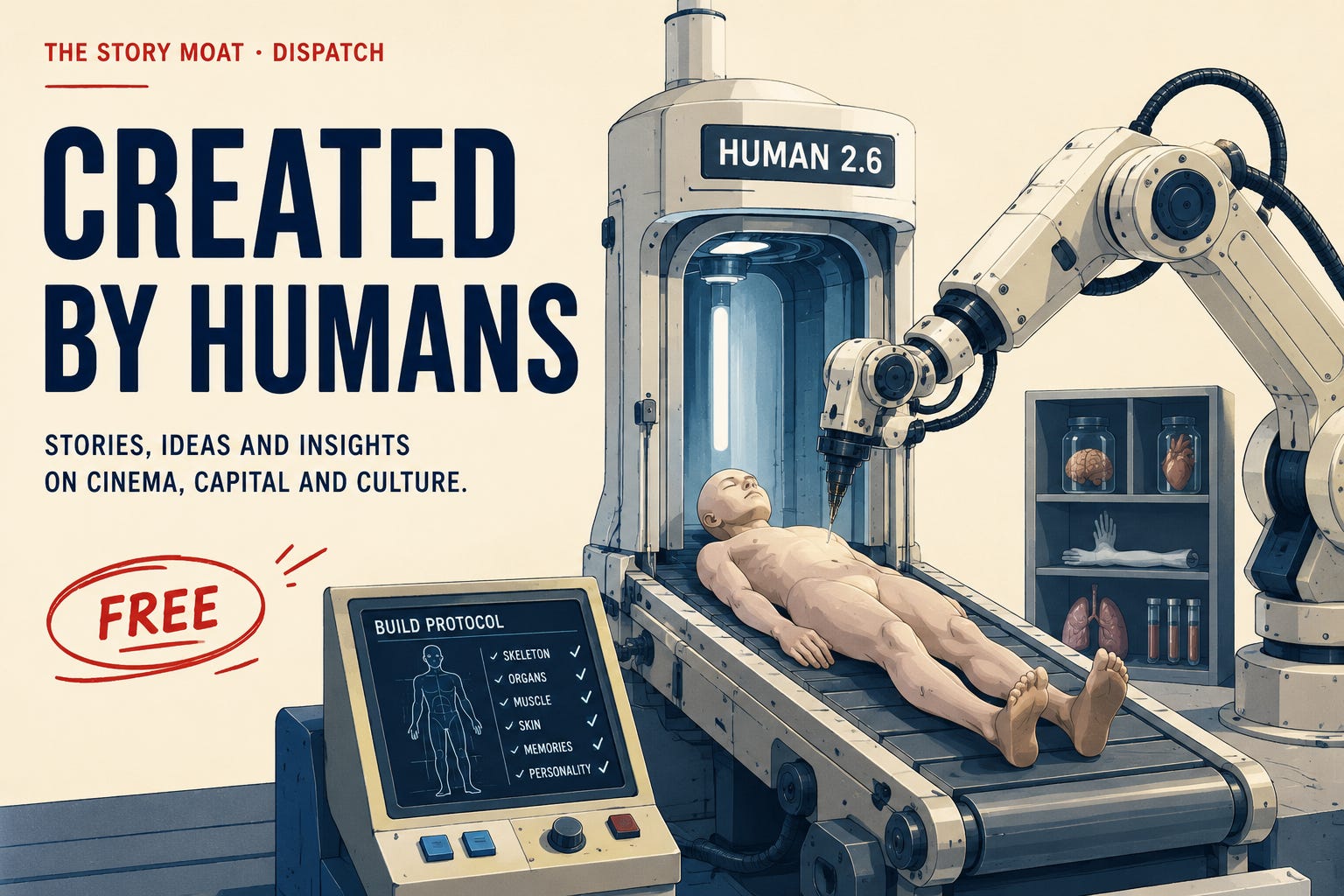
Four things every Indian creator needs to hold on to.
One. Execution is collapsing in value.
Every major technological revolution automates procedural work and pushes human value toward judgment.
Printing reduced the value of manual copying. Photography displaced parts of commercial portraiture. Spreadsheets automated large parts of bookkeeping. CGI moved matte painting from glass and canvas into digital compositing. The work did not always disappear. Its procedural layer was automated, while its judgment layer survived.
The closest media parallel is 1927. Sound rapidly ended some silent-era careers and forced others to reinvent themselves inside it. Every current creative role is now standing roughly where silent-era stars stood in 1928. Some will figure out how to talk. Some will keep miming to a room that has stopped watching.
AI is running the same pattern, at compressed speed. The half-life of “safe” work — the work an AI cannot yet do — is no longer measured in decades. It is measured in quarters. What was a defensible skill in December is a commodity by June.
Across previous transitions, the workers who adapted best were often those who moved from execution toward judgment. This time, they will need to move faster.
Two. Production is no longer the constraint. Selection is.
The clearest way to see the human premium is to see what AI is doing to the middle.
AI makes average abundant. Excellence becomes harder to fake. If your contribution ends at execution — writing the copy, cutting the video, producing the poster — AI is already compressing its price. If your value includes knowing what should be written, cut or published, AI becomes leverage rather than replacement.
There is a name worth giving to what is happening to the human worker in that second bracket. Call it Decision Density.
Decision Density is the number of consequential creative choices a person must make once generation becomes almost free.
A creative director who once reviewed a handful of viable options may now face hundreds. AI has not made her more productive in the traditional sense. It has made her responsible for exponentially more decisions. The modern creative leader is valued by the quality of the decisions she can make at generative scale.
The economics that follow are unforgiving. If two designers can each generate hundreds of posters a week, the poster has not doubled in value. It has fallen — supply has multiplied while demand stays roughly constant. What has risen in value is the ability to look at the thousand posters and choose the one nobody else would have picked.
Production is no longer the constraint. Selection is.
Above that shift, human value separates by taste, judgment, and conviction — each more expensive than the last. Taste is choosing between infinite possibilities. Judgment is compressed experience — knowing which ending an audience will reject before they walk out. Conviction is the willingness to make a bet the prediction models would have priced badly. Conventional models would have struggled to price The Blair Witch Project, Parasite, or Everything Everywhere All At Once before the audience proved them.
Innovation begins where prediction ends. AI predicts. Humans gamble.
A note on vocabulary before the next section. A year ago we called this dynamic “human in the loop” — the human validating the machine’s output before it shipped. That framing already looks quaint. In the best modern pipelines, the human is defining the work, and the machine is executing it. The AI produces. The human authors. The AI drafts. The human decides. The AI generates. The human originates. And in every technology transition, a temporary caste rises — books get written, courses get sold, a language gets built on top of it. Prompt fluency will diffuse quickly. Judgment will not.
Prompt engineering is a temporary edge. Judgment is the durable one.
Three. Content is abundant. Trust is scarce.
The bottleneck in media has moved. For a hundred years, the constraint was production. Making media was hard. Consuming it was hard. Scarcity sat with the maker.
AI has flipped that math.
Each media revolution makes one layer abundant and pushes value upward. Printing made reproduction cheaper. The internet made distribution cheaper. Search made retrieval cheaper. Generative AI is making production cheaper. Each time, the premium moves toward the layer technology cannot commoditise as quickly. This time, that layer is trust.
Some early evidence is already visible in the places you would expect it to show up first. A 2026 Semrush analysis of 42,000 blog pages found that pages classified by GPTZero as human-written occupied the top Google position substantially more often than those classified as AI-generated. That does not prove Google rewards human authorship. It does suggest that originality, expertise, and editorial intervention remain strongly associated with top-ranking work. When CNET published seventy-seven AI-assisted finance explainers, it later issued corrections on forty-one. Some pieces were also accused of reproducing language or structure from existing sources.
When production is cheap, everything looks good. The average poster is competent. The average edit is functional. The average post is publishable. Which means the cost of being average has fallen to zero, and the reward of being average has fallen with it.
Content is infinite. Attention is not. Trust is scarcer than either.
The reader has stopped asking “who made this?” and started asking “why should I believe this?” A fully automated pipeline struggles to answer that question on its own. A named and accountable human answers it more credibly.
Which is why the trust economy is quietly becoming an identity economy. Readers subscribe to Sid’s newsletter, not Substack. Viewers follow MrBeast, not YouTube. Investors listen to individual analysts more than they read consulting firms. Trust may be distributed by platforms, but it increasingly attaches to named people. In the AI decade, the strongest asset a creative company can hold is not a distribution deal or a technology stack. It is the named person whose taste the audience already knows how to spell.
My prediction: within a decade, the outputs themselves will carry the same shift. “Human Directed” will begin appearing on posters the way “Organic” appears on food, and the way “hand assembled” appears in luxury advertising. It may begin as positioning. It may end as a certification tier.
Four. Intelligence can be automated. Accountability cannot.
Underneath every one of these shifts sits a deeper one.
Every meaningful creative decision has an owner. Someone signs the cheque. Someone takes the criticism. Someone apologises when the story fails, the facts are wrong, or the audience feels betrayed. AI has no reputation to lose. It cannot feel embarrassment, accept blame, or bear the consequences of a bad decision. Responsibility remains stubbornly human.
In an age where intelligence is abundant, accountability may become the most valuable creative asset of all. The person who can be trusted to own the outcome — publicly, professionally, personally — is the person a decision requires. That is what the audience is really paying for when it pays the human premium. Not craft. Not taste.
Answerability.
— · —
The Indian workshop.
Four instructions for the Indian producer, studio head, writer, and star.
Do not mistake prompt fluency for durable creative value. Keep the person who can recognise what is worth making, not merely the person who can make the model produce it faster.
Hire for judgment, then train for tools. The tools will change. The record of choices a person has made is the more durable signal.
Put a human signature on the work. Make the writer, director, editor or creator visible in the campaign. In a synthetic-content market, authorship becomes part of the product information.
Own the “no.” One of the most valuable people in any future studio will be the person who can look at fifty machine-generated concepts and reject forty-nine. That is not a job description a machine can hold. It is the job the machine exists to serve.
— · —
The first age of media rewarded whoever owned the presses. The second rewarded whoever owned distribution. The third rewarded whoever mastered the algorithm.
We spent two centuries teaching machines to think. The next century will reward the humans who remember how to judge — and are willing to sign their name to the answer.
AI makes execution abundant. Human judgment carries the consequence. Value follows scarcity.
— · —